







 All Insights
Agentic AI Is Here – What Investors Need to Know

Agentic AI: Investment Insights for Financial Advisors
AI is advancing at breakneck pace, accelerating far more quickly than traditional innovation cycles. Breakthroughs that once took years now arrive in months, reshaping what’s possible across technology and society.
Today, Agentic AI represents a step change in automation and intelligence. Agentic systems don’t just respond, they act. With this ability, Agentic AI could reshape how businesses operate and where future value is created.
In this article, we explore Agentic AI – what it is, the business opportunities it unlocks and where we believe the greatest value is likely to be created.
01: Agentic AI Can Take Action, Representing a Step Change in the AI Evolution
While interpretations vary, the most accepted definition of Agentic AI is an AI system capable of independently planning and executing tasks on behalf of a user to achieve a specific goal.
It represents a significant evolution beyond Traditional and Gen AI:
- Traditional AI and automation tools are rule-based and require human input at every stage.
- Gen AI introduced flexibility by creating content in response to prompts but still relies on users to guide each interaction.
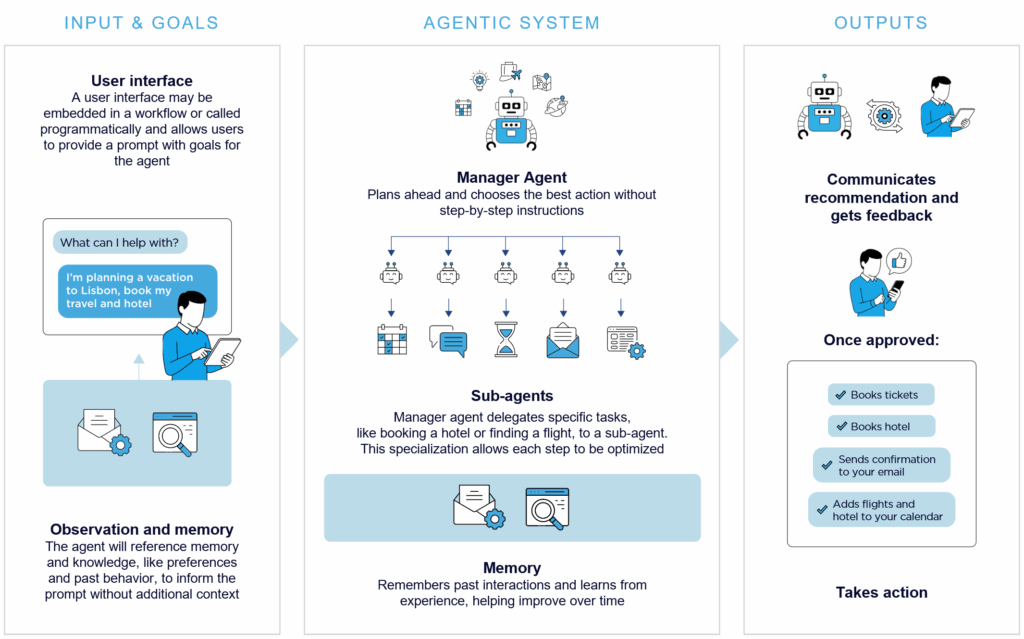
Agentic AI goes a step further. It understands goals and can autonomously plan, make decisions and take initiative without constant human direction. It can direct other AI agents to do tasks and delegate individual pieces of work – like making calculations or retrieving data from another system. This autonomy makes it more capable of managing complex workflows end to end.
Let’s apply this framework to an example. Today, an emerging use case for Gen AI is to develop an itinerary for your vacation – researching places to stay, towns to visit and well-reviewed activities. Agentic AI will go further and book those activities for you.
INVESTOR INSIGHT
AI technology is evolving at unprecedented speed, with Agentic AI marking the next big leap. The rapid pace of change means investors should pay close attention to where these breakthroughs are turning into real business impact.
Agentic Operating System1
02: Agentic AI Is Suited to a Vast Range of Business Applications
Agentic AI value lies in transforming human-dependent services into scalable, always-on applications. By embedding it into the backbone of the business, small productivity gains can compound into significant enterprise value.
Thanks to its contextual awareness and ability to operate across systems, Agentic AI can be applied across functions and industries. In customer support, for instance, an AI agent can interpret sentiment, reference past interactions and deliver real-time responses to customers. While AI can accelerate certain workflows, it lacks the capability to fully replace mission-critical enterprise systems, especially in highly regulated domains like finance.
For investors, these advancements signal a shift in how enterprise productivity can be achieved. As agents increasingly handle routine tasks, organizations can theoretically scale output without proportional increases in headcount, driving margin expansion. In some functions, this may result in a reimagined role for workers where they handle judgment and strategy and their team of agents handles execution at scale.
≥15%
Gartner® predicts, “by 2028, at least 15% of day-to-day work decisions will be made autonomously through Agentic AI, up from 0% in 2024.”2
INVESTOR INSIGHT
While most companies stand to benefit, value creation could diverge sharply. We believe that winning corporations will be those that evolve workflows and embed AI into core systems, backed by clear objectives, strong leadership and scalable adoption strategies.
Below are several high-impact use cases where businesses are already using or planning to use Agentic AI in the next six months according to a PwC survey.3
Agentic Use by Business Function

Select Traits of Successful Corporate AI Adopters
Organizations that achieve lasting value from AI share the following practices that distinguish them from those experimenting without impact:4
- Clear Objectives: Prioritize AI initiatives tied to measurable business outcomes.
- Integrated Workflows: Embed AI into core systems used by end users.
- Executive Sponsorship: Back efforts with senior leadership and cross functional support.
- Iterative Approach: Launch pilots with a plan to scale based on results.
- ROI Tracking: Use dashboards to measure and communicate business impact.
03: Agentic AI Requires Infrastructure at Massive Scale
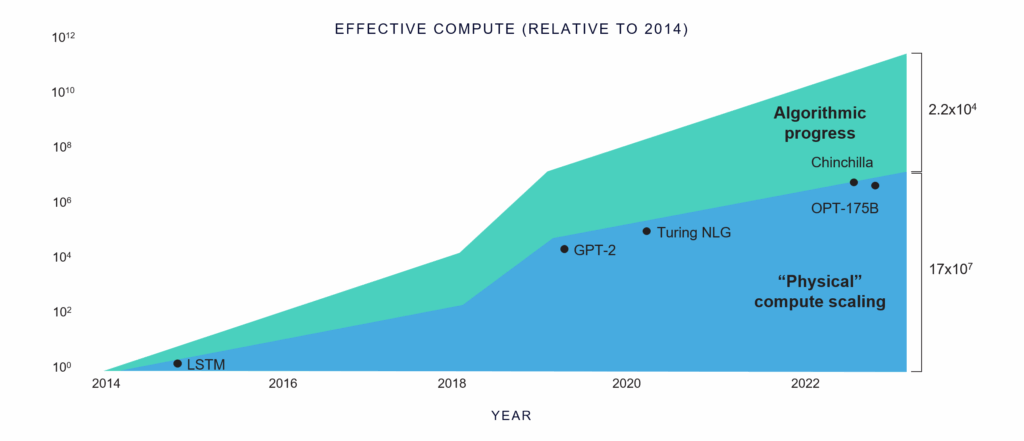
These investments – driven largely by cloud hyperscalers like Google, Microsoft and AWS, and semiconductor providers like NVIDIA – reflect the massive infrastructure demands required to train and run foundational models at scale.
Unlike traditional software, which operates on deterministic logic and predictable compute cycles, Agentic AI relies on large models, real-time inference and constant access to structured and unstructured data. This creates intensive infrastructure needs at the platform level, including high-performance compute, storage and data orchestration.
Enterprise buyers won’t need to invest in this infrastructure themselves, but they will need to pay for access. As agentic capabilities become embedded into software products, companies should expect new licensing models and pricings, creating a new layer of spend within enterprise IT budgets.
By 2030, supporting Gen AI and Agentic AI could require up to $5.2TN in AI-specific data center investment globally.5
INVESTOR INSIGHT
Foundational investments in compute and infrastructure are being made by hyperscalers and model providers, not enterprises. Corporations will access these capabilities through platforms and software providers, creating new spend categories within IT budgets rather than requiring infrastructure build out.
04: Through Agentic AI, Software Becomes a Beneficiary
While startups drive experimentation, established software providers hold a structural advantage when delivering agentic capabilities. These platforms operate at the core of enterprise workflows and benefit from:
- Proprietary data and domain-specific workflows
- Deep understanding of customer needs
- Demonstrated ability to deliver on compliance and security
- Longstanding, trusted customer relationships
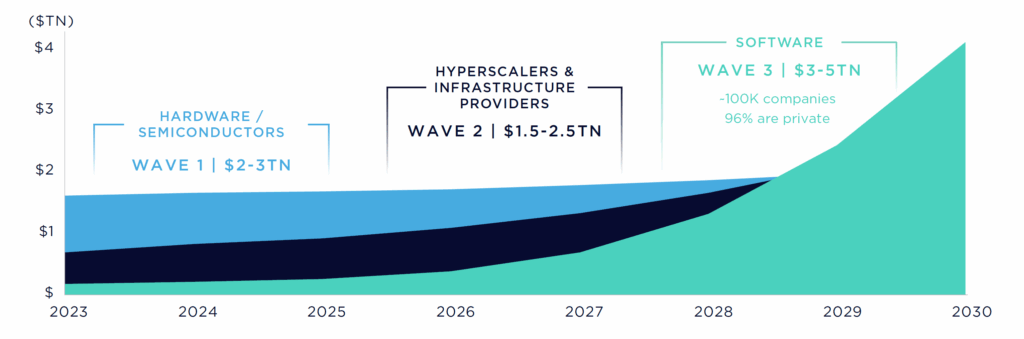
We believe that Agentic AI will follow the same multi-wave value creation cycle seen in past technology shifts, like the internet.
- Wave One: Hardware and semiconductor providers benefit from supplying foundational compute.
- Wave Two: Cloud hyperscalers gain from making AI accessible at scale.
- Wave Three: Durable value shifts to enterprise software, which bridges powerful AI models with real-world business applications.
That said, success isn’t guaranteed. Delivering at scale will require more than integration. Software companies must evolve strategy, modernize applications and build AI-ready teams. The winners will be those that align execution, infrastructure and operating models with an AI-forward future.
$1.24TN
The amount worldwide IT software spending is projected to reach by 2025, representing a 14% growth from the previous year. This is despite rapid advances in AI tools.7
INVESTOR INSIGHT
As in prior technology waves, durable value is expected to shift from infrastructure to applications. Enterprise software that embeds agentic capabilities into proprietary data and workflows could drive the next era of growth.
Cumulative Projected Gen AI-Driven Value Creation8
05: Agentic AI Can Drive Cost Efficiencies and Revenue Impact in Software
As AI matures, enterprise software platforms that successfully integrate intelligent agents will become even more entrenched – driving deeper customer reliance, increasing switching costs and strengthening their competitive moats.
60%+ of the software market could be made up of agents by 2030, according to Goldman Sachs.9
INVESTOR INSIGHT
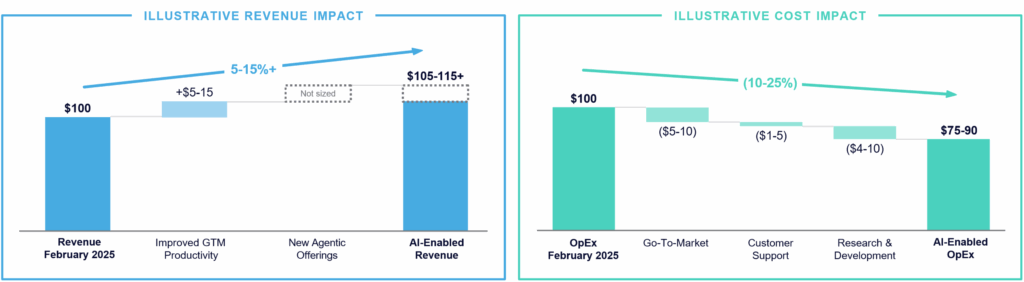
The dual upside for software lies in revenue expansion and cost efficiency. Software companies that integrate Agentic AI into their product offering can unlock new monetization while simultaneously reducing expenses.
Modern AI Opportunity for Enterprise Software10
Final Thoughts
Agentic AI marks a meaningful evolution in how intelligence is applied within businesses. While the use cases span functions and industries, enterprise software could be one of the greatest beneficiaries, serving as the distribution layer for agentic capabilities.
For investors, this can represent a pivotal moment to explore the range of investment opportunities that won’t just enable the AI shift – they’ll shape the next era of enterprise value creation.
Download the Chartbook



Maintaining Your Competitive Advantage as a Software CEO

Powering Innovation Across the Portfolio: How Vista’s Hackathons Advance AI and Enterprise Software